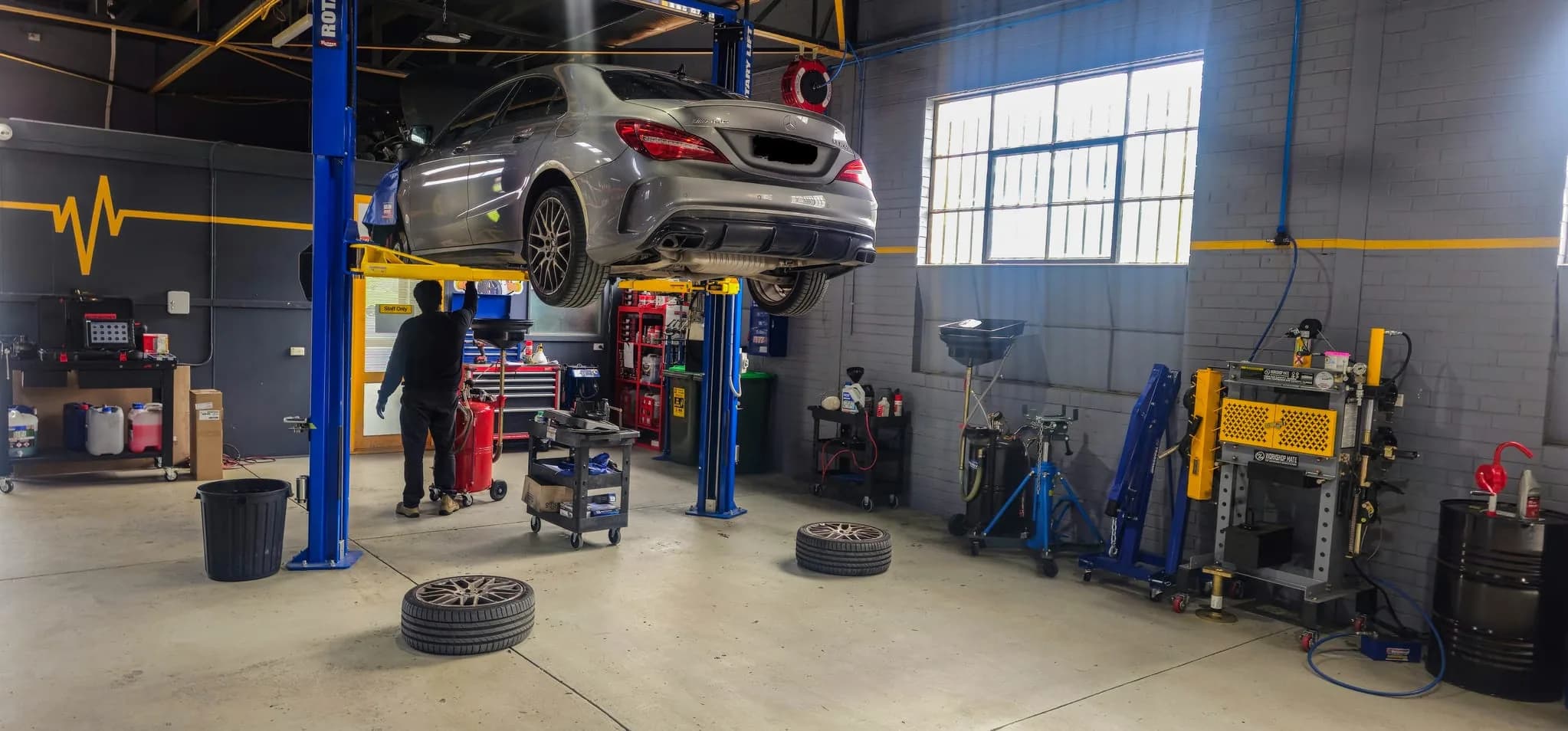
An EV service in Melbourne generally runs $165 to $670 a visit depending on the make, and most owners spend somewhere between $340 and $450 a year. That’s meaningfully less than an equivalent petrol car, because there’s no oil, no filters and no spark plugs.
What it doesn’t mean is that an EV looks after itself. The costs simply move somewhere else, mostly to tyres, and that part surprises people. This guide covers what you’ll actually spend and where.
EV service prices in Melbourne, 2026
These are estimates only, a guide rather than a quote. What you pay depends on the make, the interval and what the inspection finds.
| Job | Typical price |
|---|---|
| Annual mechanical service and safety check | $180 – $400 |
| BYD scheduled service, minor to major | $165 – $635 |
| Wheel alignment, Hunter HawkEye Elite | $90 – $300 |
| Brake service, clean and recondition | $250 – $550 |
| 12-volt auxiliary battery replacement | $180 – $450 |
| Cabin filter, wipers and fluids | $80 – $180 |
| Tyres, per corner, EV-rated | varies by size |
For comparison, most brands publish annual averages in the $226 to $558 range, and BYD’s capped-price schedule averages a little under $400 a year. Tesla is the outlier: it has no fixed service schedule at all, only recommended checks, which is genuinely cheaper but does mean nobody reminds you.
Where the money actually goes: tyres
If you own an EV and you’re surprised by a bill, it’s usually this one.
Electric cars are heavy, and they deliver full torque from a standstill. Both of those things chew tyres. An EV typically goes through tyres 20 to 30 percent faster than the same-sized petrol car, and considerably faster than that if the alignment has drifted or the driving is enthusiastic. A Tesla Model Y on the wrong alignment can strip a set in well under 20,000 km.
Two things genuinely help. Get the alignment checked at every service rather than every second one, because a small error costs far more in rubber than it does to correct. And fit tyres rated for the weight and the torque, which is why EV-specific tyres exist and why the cheap set is rarely the cheap option.
We cover the tyre side in more detail in our Tesla and EV tyres guide.
The jobs an EV still needs
Brakes, and this is counter-intuitive. Regenerative braking means the friction brakes barely get used, so discs corrode and calipers seize from sitting idle rather than from wear. EV brake work is usually cleaning, freeing and servicing rather than replacing.
Suspension and steering. Battery weight rides on ordinary bushes, control arms and shocks. Clunks over speed humps are the most common EV complaint we see.
The 12-volt battery. Every EV has one, it runs the computers and the door locks, and when it dies the car is as stranded as any petrol car with a flat battery. Cheap to test, cheap to replace, genuinely inconvenient to ignore.
Cabin filter, wipers, washers and lights. Unglamorous and still on the schedule.
Logbook servicing. EVs have a service schedule, and following it keeps the mechanical warranty intact.
What we don’t do, and why that saves you money
High-voltage battery packs, their cooling circuits and HV electrical faults go to the manufacturer’s network. They have the equipment and the training for it, and pretending otherwise with a car worth this much helps nobody.
The practical value of that line is the diagnosis. Plenty of the faults that feel like an expensive battery problem turn out to be a 12-volt battery, a wheel bearing, a seized caliper or a suspension bush. Being told which side of the line your problem sits on, before you book a dealer appointment, is often the cheapest hour you’ll spend on the car.
Is servicing an EV at an independent workshop safe for the warranty?
Yes, for the mechanical side, under the same Australian Consumer Law principles that apply to any car. Your new-car warranty can’t be voided simply because an independent workshop did the work, provided the service is done at the correct interval, by a qualified mechanic, to the manufacturer’s specification, and documented in the logbook.
The high-voltage system is the exception, and not because of warranty rules. It genuinely belongs with the manufacturer.
We service Tesla, BYD, Polestar, MG and most other electric cars at Knoxfield. If you’re not sure whether your problem is ours or the dealer’s, call and describe it. We’ll tell you straight, including when the answer is that you need the dealer.
Call 03 9763 0100 or book through our EV service page. We’re at 5/1644 Ferntree Gully Road, Knoxfield, and we’re open Saturdays.