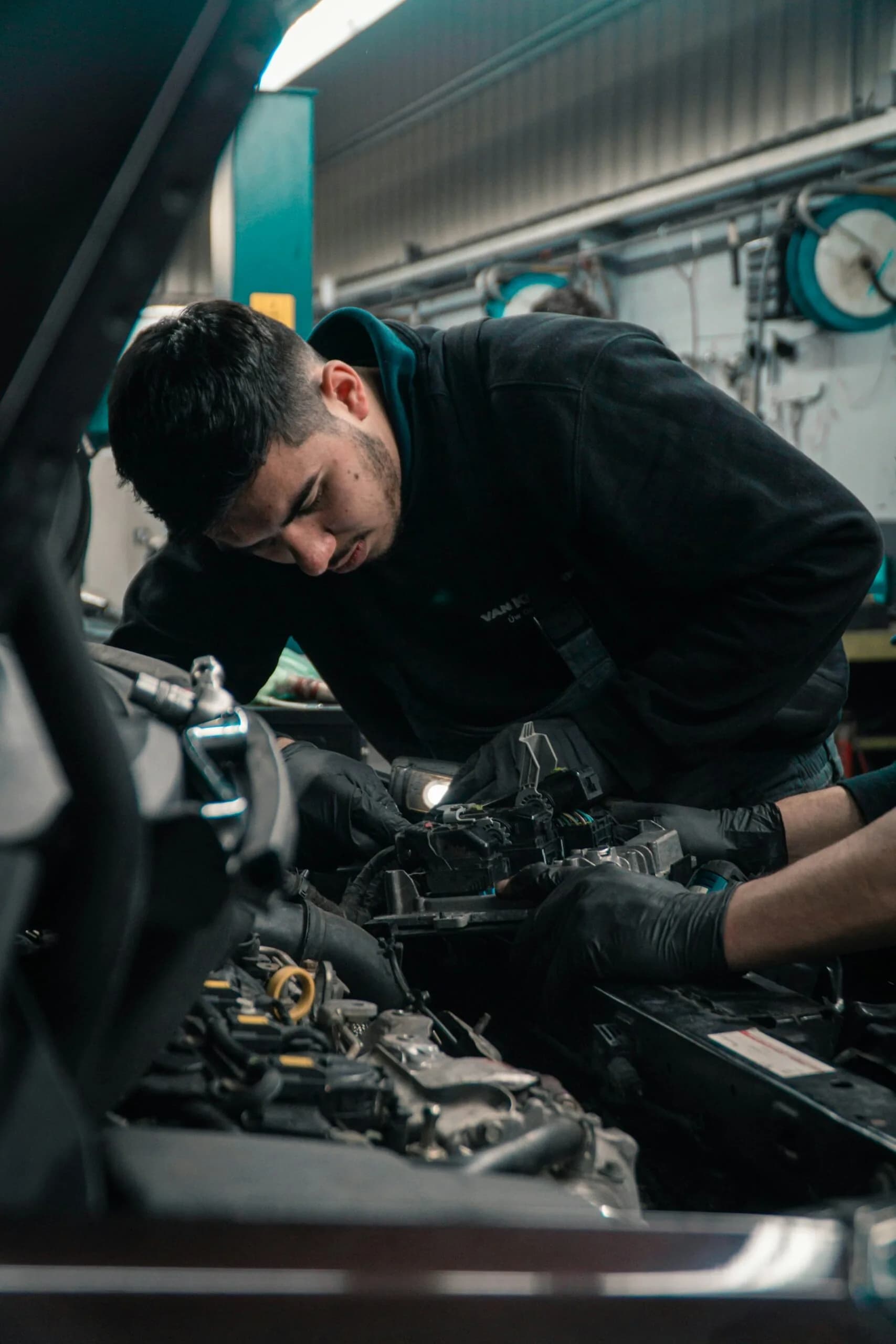
If your car air conditioning is blowing warm air in a Melbourne summer, you’re not alone. It’s the single most common reason drivers walk into our Knoxfield workshop between December and March. The good news is most AC problems can be fixed the same day, for a lot less than a dealership charges. The bad news is that an AC that was blowing cold and suddenly turns warm usually means a small problem has grown into a bigger one.
This post explains what a car air conditioning service in Melbourne actually involves, what common AC problems cost to fix, and how to tell whether you need a leak repair, an electrical fix or a full compressor replacement.
What a car air conditioning service covers
A proper AC service at our Knoxfield workshop covers four things. A refrigerant top-up on its own is not a service.
System pressure test. We pressure-check the system to find leaks before adding new gas. Topping up a leaking system without fixing the leak is throwing money away, because the gas will be gone again within months.
Leak detection. If the pressure drops, we use UV dye and an electronic leak detector to find the exact failure point. It’s usually a hose, an O-ring, the condenser or the evaporator.
Compressor and clutch check. We make sure the compressor cycles correctly, the clutch engages, and the vent temperature drops to spec (usually 4–8°C at the centre vent on a 25°C day).
You leave with a written report showing the system pressure readings, refrigerant added, vent temperature and any leak findings.
Common AC problems and what they cost in Melbourne
Nearly every car AC problem we see falls into one of five categories.
Low refrigerant from a gradual leak. This is the most common one. The fix is finding and repairing the leak, and the price depends on which part is leaking. If the pressure test shows the system is actually leaking, we quote the seal or O-ring repair separately once we've found where it's going — topping up a leaking system without fixing it is money you'll spend again by Christmas.
Faulty compressor. Compressor replacement typically runs $800–$1,500 fitted for most cars. The receiver-drier and system flush that should always be done at the same time are quoted with it, and European and larger systems sit above that range — we'll give you the full figure in writing before anything comes apart.
Blocked cabin air filter. This often shows up as weak airflow that gets blamed on the AC. Replacement is $45–$90 and takes 10 minutes.
Broken AC fan or blower motor. $280–$650 supplied and fitted. A common failure on cars over 7 years old.
Failed condenser. Often caused by a stone strike through the front grille. Replacement is $650–$1,400.
Most of what we see is the first category, a slow refrigerant leak that has finally reached the point where the system can’t hold pressure. Caught early, it’s the cheapest fix on the list.
Signs your car AC needs attention
Don’t wait for the cold air to disappear entirely. These are the early warnings:
Vent air is cool but not cold. Refrigerant is low. Have it pressure tested now, before it stops working entirely on a 35°C+ day.
AC works on the highway but not in stop-start traffic. Compressor or condenser cooling problem.
Funny smell from the vents when the AC starts. Mould in the evaporator. A cabin filter and an antibacterial treatment fix this.
Hissing or clicking sounds. Refrigerant escaping through a leak, or the compressor clutch struggling.
Water dripping inside the cabin. The drain hose is blocked. A quick fix, but do it before the carpet stains.
AC light flashes or won’t turn on. The car’s ECU has picked up a system fault. It needs a diagnostic scan.
Why Melbourne summers are especially hard on car AC
Melbourne car AC systems take more punishment than most people realise.
Sustained high heat. Multi-day stretches of 35°C+ in January and February push compressors to their limit.
Pollen and dust. Spring pollen and summer construction dust clog the condenser cooling fins.
UV. Cars parked outside all day in the Knoxfield, Wantirna or Bayswater sun age their rubber AC hoses and seals faster.
Stop-start traffic. Crawling along the Monash, Eastlink or the Eastern Freeway in a summer peak gives the system no cool airflow to recover with.
The practical upshot: book a preventative AC check every 2 to 3 years, ideally in October or November so any repairs are done before summer really hits.
R134a vs R1234yf: which refrigerant does my car use?
Two refrigerants are common in Australian cars.
R134a. Used on most cars built before 2017.
R1234yf. Used on most European cars from 2017 and a growing number of Japanese cars. More expensive (the gas itself costs 5–8× more than R134a) but better for the environment.
Your car’s refrigerant type is usually printed on a sticker under the bonnet, near the engine bay or on the radiator support. If you can’t find it, your make and year is all we need.
Should I use a DIY aircon top-up can from Supercheap?
Honest answer: no, with one exception.
DIY top-up cans skip the most important steps of a proper service: pressure testing, leak detection and evacuation. They just add more refrigerant to a system that probably has a leak. The gas escapes again within weeks, and the extra moisture that gets in through DIY fittings can corrode the compressor from the inside over time. We’ve replaced compressors that died early because of DIY top-up damage.
The one exception: if you have a near-new car (under 3 years old) and the AC has been slightly underperforming for one summer, a workshop pressure and leak check is the right call. Still not a DIY can.
European car AC service
BMW, Mercedes, Audi, Porsche, VW and Volvo AC systems are more complex than most Japanese setups. Three things make them different:
R1234yf refrigerant on most models from 2017.
Climate control coding after a compressor replacement on some BMW and Mercedes models. This needs a dealer-level diagnostic tool to clear the fault.
OEM-specific compressor oils. Using the wrong oil shortens compressor life dramatically.
We service all of these in-house at Knoxfield. The same Master Technician handles your car as would at a dealership, at independent workshop pricing. See our European cars page for what we cover across the European makes.
How to get the most out of an AC service appointment
Run the AC on the way in. If we can experience the symptom first-hand, diagnosis is faster.
Note when the problem started. A gradual decline points to a slow leak. A sudden loss usually means compressor failure or a major hose leak.
Bring records of any previous AC work. This helps a lot if the system has been opened before.
Ask for the vent temperature in °C on the written report. That number tells you whether the system is performing to spec.
Other services to consider while you’re here
If you’re due for an AC service, a few related items often save a return trip:
Car battery replacement. Melbourne summers kill batteries faster than winters do. Free testing while we have your car.
Radiator and coolant check. The same heat that loads the AC also stresses the cooling system.
Alternator check. AC works the alternator hard. Worth checking it’s keeping up.
Free tyre check. Same-day tread, pressure and condition inspection at no charge.
Book a car air conditioning service in Knoxfield
Drop in to Tyre Doctors at 5/1644 Ferntree Gully Road, Knoxfield, or call 03 9763 0100. Most AC services are done the same day. Compressor replacements are next-day. Diagnosis is free and no-obligation, with a written report and quote before any work starts.
Visit our Car Air Conditioning Service Melbourne page for booking and indicative pricing. Open Monday to Friday 8–5, Saturday 10–3. Servicing Knoxfield, Wantirna, Wantirna South, Boronia, Bayswater, Ferntree Gully, Rowville, Scoresby, Glen Waverley and the wider outer-eastern Melbourne area.